AI Education - Bringing the Latest AI into Learning
August 26, 2025
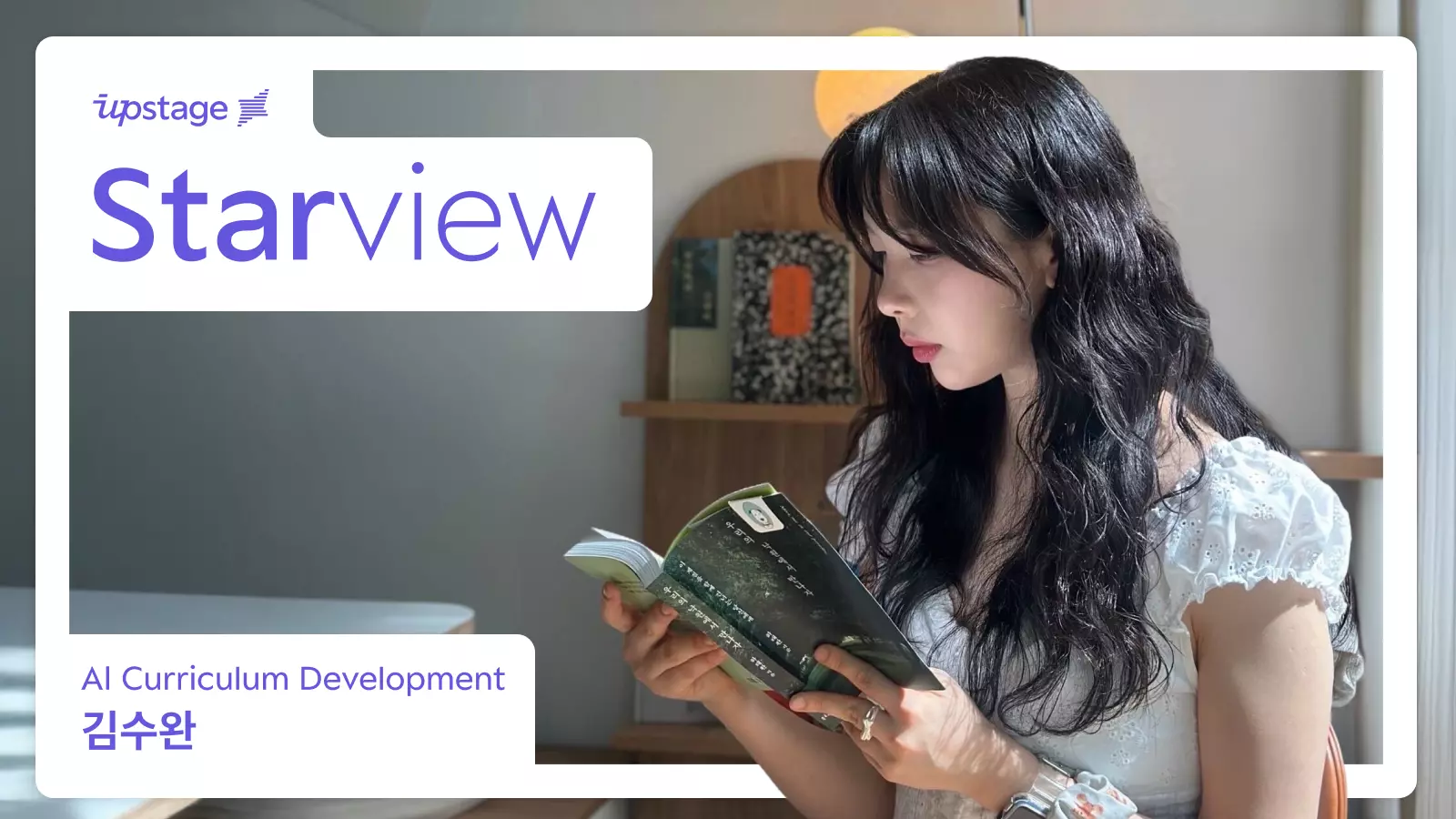
At Upstage, we call our colleagues “Stars.” Today, more than 140 Stars are working together on a journey to build AI that changes the world.
Mini Starview is a special interview series where Stars from different roles share their work, experiences, and growth stories in their own words. If you're curious about how we work at Upstage, our culture, and the real growth journeys our Stars have experienced, we invite you to explore this Mini Starview.
We hope this content provides helpful insight for future Stars considering joining Upstage and serves as a meaningful guide as you shape your
career path.
In this Mini Starview, we introduce the AI Education team, where AI specialists and education experts come together to design the learning
experiences the world needs. By connecting Upstage’s AI technology and knowledge with learners, the team helps people grow while cultivating AI talent and narrowing the gap between education and real-world practice. Today, we meet Wanda Suwan Kim, an AI/LLM Curriculum Developer who designs and develops AI education programs.
Q. Hello! Could you briefly introduce yourself?
Wanda: Hello, I’m Wanda, an AI/LLM Curriculum Developer in the AI Education team at Upstage. My role is to design and develop AI education programs, exploring where technology and education intersect and shaping new directions for learning.
Q. What are the main responsibilities or projects you handle in your current role?
Wanda: A Technical Content Creator is, quite literally, someone who develops educational content. When launching a new education
initiative, we first define the target learners and design curricula based on market research and analysis of the latest trends.
Recently, I’ve been exploring a new area called Embedded AI, conducting research and analysis to develop new curricula around it.
Another key part of my work is translating rapidly evolving technologies into learning experiences. For example, I designed and built a Promptathon, a competition where participants improve task performance purely through prompting. I also incorporate emerging technologies such as RAG and AI agents into educational projects to create practical, real-world use cases.
In addition, I develop tutorial content that helps users easily adopt Upstage’s AI products, designing tailored tutorials for learners with different backgrounds—from non-developers to experienced engineers.
Q. What has been the most challenging or rewarding moment in your work?
Wanda: When tackling real-world problems in projects, we first consider which approach is most appropriate: whether a task requires model fine-tuning, whether it needs RAG to inject external knowledge into an LLM, or whether it can be solved through prompting
alone.
In one case, we determined that a proofreading task could be solved purely with prompting, which led us to design a Promptathon competition where students worked together to address the challenge.
Designing the competition—from the structure to the evaluation metrics—required close collaboration with the Enterprise Product
team and the Model team. Since this was an entirely new type of competition that hadn’t existed before, it was challenging but also
one of the most memorable projects I’ve worked on. Seeing product usage reach around $1,300 during the event made the experience even more rewarding.
Q. What is the most valuable lesson you’ve learned from collaborating with colleagues in the same role?
Wanda: My background is primarily in AI technology, so when designing curricula I initially felt I lacked a strong educational
perspective. Fortunately, I’ve been able to learn a great deal from colleagues who specialize in education. For instance, while designing our current instructor training program, we’ve gone beyond simply providing teaching materials.
We are developing instructor guidelines that help teachers effectively run classes, simulation-based evaluations to assess instructors’ understanding, and structured lesson plans to support course delivery. Through these collaborations, I’ve been exposed to many
educational methodologies that help us build more complete and effective programs.
Q. How have you grown since joining Upstage?
Wanda: Before joining Upstage, I mostly focused on creating materials to deliver knowledge.
Since joining the AI Education team, however, my perspective on education has expanded significantly.
At Upstage, education isn’t just about explaining AI theory—it’s about thinking deeply about how real-world problems can be
translated into learning experiences. Through this process, I’ve come to see education not just as teaching, but as a project where we define problems and explore solutions together.
Q. What do you hope to achieve at Upstage in the future?
Wanda: Upstage is a company that not only develops AI technology but also focuses on applying it to solve real-world problems.
In this environment, I hope to continue turning new AI technologies into educational experiences as quickly as possible, helping more
people build problem-solving capabilities through learning. Since I enjoy learning new things quickly, structuring them, and sharing
them with others, I hope to keep integrating emerging technologies into education and helping more learners experience how AI can
transform the way we work.
Q. How does your team collaborate and work with other teams?
Wanda: Our education team is broadly divided into three parts: education business development, program and project operations
(PM), and curriculum development. When technical consultation is needed, we collaborate with the Model and Product teams.
When our products are used in educational events, we collect feedback and relay it back to the product teams. Sometimes, internal
product teams or external partners—such as EBS or EP—bring us real problems they want to solve, and we incorporate those
challenges into our curriculum so that learners can tackle them as part of the learning process.
Q. Was there anything that impressed you when you first joined Upstage?
Wanda: When I first joined the company, I simply enjoyed organizing knowledge and sharing it with others.
But after joining the Upstage Education team, I realized that education can be much more than teaching—it can be a project that
directly connects to solving real-world problems. At first, I worried whether I could fully incorporate educational perspectives into my
work. However, through collaboration with colleagues, I’ve been able to fill in those gaps, and now I approach education as a project
that can be planned, designed, and continuously improved.
Q. Do you have any practical advice for candidates interested in this role?
Wanda: Because this role involves creating content for learners with diverse backgrounds, understanding the audience is extremely
important. The way you teach developers, non-developers, or enterprise clients can vary significantly even when the topic is the
same. It’s worth thinking deeply about who your learners are and how their needs differ.
Another important factor is having your own educational philosophy. If you have a clear perspective on what good education looks like, it becomes much easier to maintain direction even while experimenting with new ideas.
Finally, enjoying new challenges is essential. There are many situations where we need to quickly learn unfamiliar technologies or
domains and translate them into educational content. Having the mindset to embrace and enjoy that process makes a big difference.
Q. Is there anything you’d like to say to candidates considering applying to Upstage?
Wanda: Upstage is not just a company that is good at AI—it’s a place where people constantly think about how AI can benefit the
world. If there’s something you want to try, this is an environment where you can move quickly and turn ideas into reality with your
team. If you are ready to keep learning and growing, I’m confident that Upstage can be the best place to accelerate that journey.