Data for Evaluating and Improving AI Products
August 26, 2025
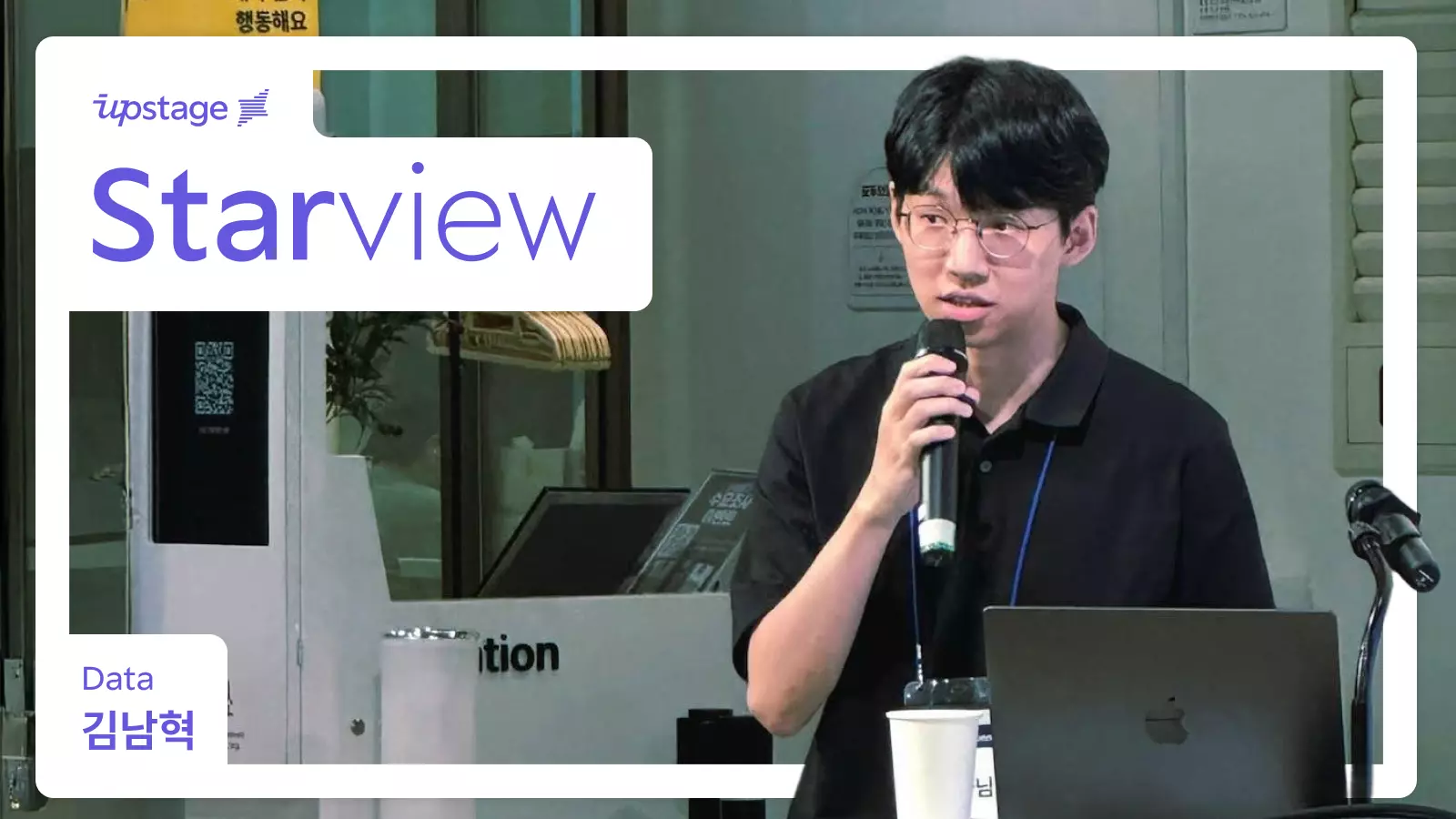
At Upstage, we call our colleagues “Stars.” Today, more than 140 Stars are working together on a journey to build AI that changes the world.
Mini Starview is a special interview series where Stars from different roles share their work, experiences, and growth stories in their own words. If you're curious about how we work at Upstage, our culture, and the real growth journeys our Stars have experienced, we invite you to explore this Mini Starview.
We hope this content provides helpful insight for future Stars considering joining Upstage and serves as a meaningful guide as you shape your
career path.
In this Mini Starview, we introduce the Data team, which accurately evaluates the current performance of AI products through data and uncovers
key insights for future growth. The team builds diverse datasets required for AI product development, evaluates product performance precisely,
and identifies critical insights for improvement. Today, we meet Namhyuk Kim, a Data Manager who works on building the data needed for AI
product development and uncovering insights to improve product performance.
Q. Hello! Could you briefly introduce yourself?
Namhyeok: Hello, I’m Namhyuk Kim, a Data Manager in the Data team within the AI Product division at Upstage.
My role involves creating the data required for the products being developed at Upstage. Recently, I’ve been focusing on how we can evaluate AI models and products more accurately.
Q. What are the main responsibilities or projects you handle in your current role?
Namhyeok: Currently, Upstage is developing two main products. The first is Information Extract, which extracts necessary information from documents into structured data, and the second is AI Space, which supports document-based workflows.
The Data team builds various datasets required for developing these products, and we place particular emphasis on designing
evaluation datasets that allow us to accurately measure AI product performance. Through this process, we also uncover key insights
that help guide product improvements.
Q. What has been the most challenging or rewarding moment in your work?
Namhyeok: One of the most memorable experiences was when I was assigned to a high-priority project for a new client. To meet both tight deadlines and high expectations, we formed a task force team and worked intensively day and night. In order to achieve the best performance, the training approaches and evaluation criteria often changed throughout the process. Each time that happened, I
quickly reorganized the data and optimized the training and evaluation environments to support the team. When the client was
satisfied and we successfully signed the contract, I felt a strong sense of accomplishment. Although it was challenging, it was also one of the most rewarding projects I’ve worked on, and it truly reflected the dynamic environment I was hoping to experience when I joined a startup like Upstage.
Q. What is the most valuable lesson you’ve learned from collaborating with colleagues in the same role?
Namhyeok: I constantly learn from my colleagues through the way they approach their work. It’s not always easy for employees to
maintain a strong sense of ownership and responsibility, but everyone here works with a high level of commitment, which motivates
me greatly. There is no “free-riding” like you might see in group projects, and that creates an environment where everyone works with genuine passion. Thanks to this collaborative atmosphere, I also feel a stronger sense of responsibility and can fully immerse myself in my work. It truly feels like we are growing together through the positive influence of our teammates.
Q. How have you grown since joining Upstage?
Namhyeok: The biggest area of growth for me has been expanding the way I view problems. Before joining the company, I focused
mainly on solving the problem directly in front of me. Now, I try to understand the broader context and background surrounding the
problem and think about more fundamental solutions. Rather than simply addressing immediate issues, I’ve learned to anticipate
potential challenges that may arise in the future and prepare for them. This shift in perspective has helped me propose solutions that
create greater long-term value.
Q. What do you hope to achieve at Upstage in the future?
Namhyeok: During my interview at Upstage four years ago, I was asked what my goal would be ten years into the future. At the time,
I answered that I hoped to become one of the leading AI data experts in Korea within ten years. That goal still holds true today, and I
have about six years left to achieve it. While others may think differently, when I reflect on my current pace of growth and the
experiences I’ve gained so far, I believe it is a goal that is absolutely achievable.
Q. How does your team collaborate and work with other teams?
Namhyeok: In AI development, data must always come first, so it is important to anticipate needs and stay one step ahead. If training data is not prepared in time, models cannot be trained, and if evaluation data is delayed, models cannot be properly validated. For that reason, it is essential to understand the overall workflow, adjust priorities depending on the situation, and deliver the best possible
results within limited time. Even after datasets are released, the work does not end. We continue to communicate closely with
engineers who use the data and continuously improve data quality and evaluation methodologies.
Q. Was there anything that impressed you when you first joined Upstage?
Namhyeok: When I first joined Upstage as my first job, I had many worries as a new employee. I often wondered whether I could
perform well without causing trouble for my colleagues, and how I could prove my value. I constantly questioned myself—“Is this
approach okay? Am I doing this the right way?” However, after experiencing several successful projects with the support of my
teammates, those initial anxieties quickly disappeared. I gradually gained confidence and was able to work at my own pace.
Looking back, everyone feels nervous and uncertain at the beginning, but eventually you learn by facing challenges directly.
In many ways, company work is not so different from the experiences you’ve already had. Even now, new challenges continue to arise, but unlike before, I approach them with confidence and a much more relaxed mindset.
Q. Do you have any practical advice for candidates interested in this role?
Namhyeok: Above all, we value the ability to solve problems with a data-centric mindset—an approach often referred to as
Data-Centric AI. Therefore, the most effective way to demonstrate your strengths during the resume, portfolio, and interview process
is to show how you have applied this mindset in practice. Even with simple modeling experience, you can highlight how you defined
and solved problems from a data-centric perspective. For example, creating synthetic data to address insufficient training data, or
designing evaluation criteria and building evaluation datasets to validate models when such data did not exist, are both strong
examples.
Q. Is there anything you’d like to say to candidates considering applying to Upstage?
Namhyeok: Many people who study AI naturally set their career goal as becoming an AI/ML engineer or researcher.
I thought the same at first. However, after working in the AI industry, I realized that there are many other roles and opportunities
available. I hope applicants will explore different paths with a broader perspective and discover the career that suits them best. The AI field offers far more diverse opportunities than many people expect, and there are many places where you can apply and grow your
capabilities.